
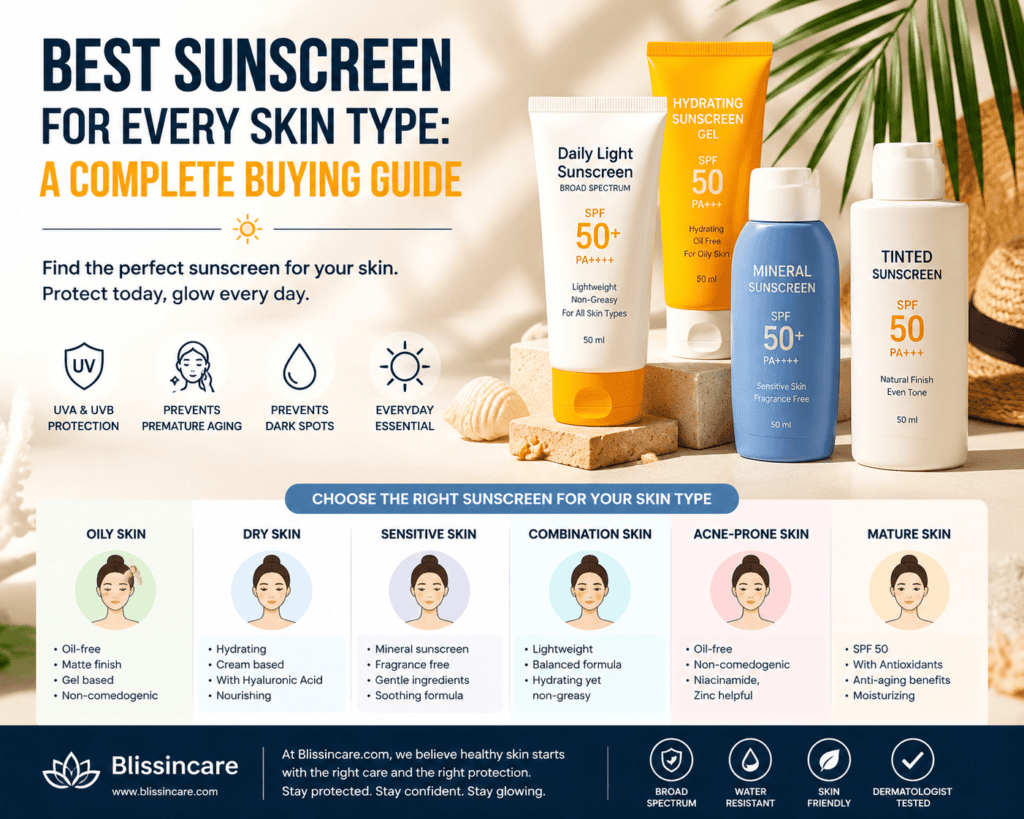
Best Sunscreen for Every Skin Type: A Complete Guide
Healthy skin starts with daily sun protection. At Blissincare, we believe that choosing the right sunscreen should be simple. Our skincare guides help you understand your skin and make better skincare decisions with confidence.
Whether you have oily, dry, sensitive, combination, or acne-prone skin, this complete guide will help you find the best sunscreen for your skin type and lifestyle.
Introduction
Many people think sunscreen is only for summer or beach vacations. That is not true. Your skin faces harmful UV rays every day. These rays can damage your skin even when the weather is cloudy or when you stay indoors near windows.
Using sunscreen daily is one of the easiest ways to keep your skin healthy. It protects your skin from sunburn, dark spots, early wrinkles, uneven skin tone, and even skin cancer.
But choosing the right sunscreen is not always easy. There are hundreds of products in the market. Some feel oily. Some leave a white layer. Others may cause breakouts or irritation.
The good news is that there is a sunscreen for every skin type. You only need to know what to look for.
This buying guide explains everything in simple words. By the end of this article, you will know exactly which sunscreen is right for you.
Why Sunscreen Is Important Every Day
The sun gives us light and Vitamin D. However, too much sunlight can damage our skin.
The sun produces two main types of harmful ultraviolet rays.
- UVA Rays
- UVB Rays
UVA Rays
UVA rays go deep into the skin. They cause:
- Premature aging
- Fine lines
- Wrinkles
- Loss of skin firmness
- Pigmentation
UVB Rays
UVB rays affect the top layer of the skin. They cause:
- Sunburn
- Skin redness
- Skin damage
- Higher risk of skin cancer
A good sunscreen protects your skin from both UVA and UVB rays.
That is why you should always choose a broad-spectrum sunscreen.
What Does SPF Mean?
SPF stands for Sun Protection Factor.
It tells you how well a sunscreen protects your skin from UVB rays.
Here is a simple guide.
| SPF | Protection |
|---|---|
| SPF 15 | Around 93% UVB protection |
| SPF 30 | Around 97% UVB protection |
| SPF 50 | Around 98% UVB protection |
For daily use, dermatologists usually recommend SPF 30 or SPF 50.
Mineral vs Chemical Sunscreen
Understanding the difference helps you choose the right product.
Mineral Sunscreen
Mineral sunscreen contains ingredients like:
- Zinc Oxide
- Titanium Dioxide
These ingredients sit on the skin and reflect sunlight.
Benefits
- Works immediately
- Good for sensitive skin
- Less irritation
- Safe for children
Drawbacks
- Can leave a white cast
- May feel slightly thicker
Chemical Sunscreen
Chemical sunscreen absorbs UV rays before they damage your skin.
Common ingredients include:
- Avobenzone
- Octinoxate
- Octisalate
- Homosalate
Benefits
- Lightweight
- No white cast
- Easy to blend
- Comfortable for daily wear
Drawbacks
- May irritate sensitive skin
- Needs about 15–20 minutes before sun exposure
How to Choose Sunscreen Based on Your Skin Type
Every skin type has different needs.
Let’s understand each one.
Best Sunscreen for Oily Skin
People with oily skin often avoid sunscreen because it feels sticky.
This is a mistake.
Your skin still needs protection.
Look for
- Oil-free formula
- Gel texture
- Matte finish
- Lightweight sunscreen
- Non-comedogenic products
Avoid
- Heavy creams
- Thick oils
- Greasy formulas
Best Ingredients
- Niacinamide
- Silica
- Zinc Oxide
- Green Tea Extract
These ingredients help control excess oil.
Best Sunscreen for Dry Skin
Dry skin loses moisture quickly.
Choose a sunscreen that hydrates while protecting your skin.
Look for
- Cream-based sunscreen
- Hydrating ingredients
- Rich texture
Best Ingredients
- Hyaluronic Acid
- Ceramides
- Glycerin
- Squalane
- Aloe Vera
These ingredients lock moisture into your skin.
Best Sunscreen for Sensitive Skin
Sensitive skin reacts easily.
It may become red or itchy after using the wrong sunscreen.
Choose products carefully.
Look for
- Mineral sunscreen
- Fragrance-free formula
- Alcohol-free
- Dermatologist-tested
Best Ingredients
- Zinc Oxide
- Titanium Dioxide
- Oat Extract
- Aloe Vera
Avoid
- Strong fragrance
- Artificial colors
- Essential oils
- Harsh preservatives
Best Sunscreen for Combination Skin
Combination skin has both oily and dry areas.
Usually,
- Oily T-zone
- Dry cheeks
Choose a balanced sunscreen.
Look for
- Lotion texture
- Lightweight cream
- Hydrating but non-greasy formula
Gel-cream sunscreens work well for combination skin.
Best Sunscreen for Acne-Prone Skin
Acne-prone skin needs special care.
Heavy sunscreen can clog pores.
Look for
- Non-comedogenic
- Oil-free
- Lightweight
- Water-based formula
Helpful Ingredients
- Niacinamide
- Zinc
- Centella Asiatica
Avoid
- Coconut oil
- Heavy butters
- Thick oils
Best Sunscreen for Mature Skin
As skin ages, it loses collagen.
Choose sunscreen that also supports healthy skin.
Look for
- SPF 50
- Moisturizing ingredients
- Antioxidants
Good Ingredients
- Vitamin E
- Vitamin C
- Hyaluronic Acid
- Peptides
Which Sunscreen Texture Should You Choose?
Different textures suit different lifestyles.
Cream
Best for:
- Dry skin
- Normal skin
Gel
Best for:
- Oily skin
- Acne-prone skin
Lotion
Best for:
- Combination skin
- Daily use
Stick Sunscreen
Best for:
- Quick touch-ups
- Travel
- Outdoor activities
Spray Sunscreen
Best for:
- Sports
- Body application
Always spray enough product and rub it evenly.
Important Ingredients to Look For
Reading the ingredient list helps you buy wisely.
Zinc Oxide
Provides broad-spectrum protection.
Titanium Dioxide
Gentle on sensitive skin.
Niacinamide
Controls oil and reduces redness.
Hyaluronic Acid
Keeps skin hydrated.
Ceramides
Strengthen the skin barrier.
Vitamin E
Protects against free radicals.
Aloe Vera
Soothes irritated skin.
Ingredients to Avoid
Some ingredients may not suit everyone.
Be careful if you have sensitive skin.
Avoid products with:
- Strong fragrance
- Alcohol (if it dries your skin)
- Heavy oils
- Artificial colors
Always patch test new products.
How Much Sunscreen Should You Apply?
Using too little sunscreen reduces protection.
Use approximately:
- Two fingers of sunscreen for your face and neck.
- One shot-glass amount for your body.
Cover every exposed area.
Do not forget:
- Ears
- Neck
- Hands
- Feet
- Back of the neck
When Should You Apply Sunscreen?
Apply sunscreen:
- 15 to 20 minutes before going outside.
- Every morning after moisturizer.
- Before makeup.
How Often Should You Reapply?
Many people apply sunscreen only once.
That is not enough.
Reapply:
- Every two hours outdoors.
- After sweating.
- After swimming.
- After towel drying.
Can You Wear Sunscreen Indoors?
Yes.
UVA rays pass through glass.
If you sit near windows or use screens for long hours, sunscreen still helps protect your skin.
Sunscreen Myths You Should Stop Believing
Myth 1: Dark skin does not need sunscreen.
Wrong.
Every skin tone can suffer sun damage.
Myth 2: You only need sunscreen in summer.
Wrong.
UV rays are present all year.
Myth 3: Makeup with SPF is enough.
Wrong.
Most people do not apply enough makeup to get full SPF protection.
Myth 4: Higher SPF means all-day protection.
Wrong.
Even SPF 100 needs reapplication.
Myth 5: Cloudy weather protects your skin.
Wrong.
UV rays pass through clouds.
Tips for Choosing the Best Sunscreen
Before buying, check these points.
✅ Broad-spectrum protection
✅ SPF 30 or higher
✅ Suitable for your skin type
✅ Non-comedogenic if acne-prone
✅ Water-resistant if outdoors
✅ Dermatologist-tested
✅ Fragrance-free for sensitive skin
Common Mistakes People Make
Many people unknowingly reduce the effectiveness of sunscreen.
Avoid these mistakes.
- Applying too little sunscreen
- Forgetting the neck and ears
- Skipping sunscreen on cloudy days
- Not reapplying
- Using expired sunscreen
- Depending only on makeup SPF
Daily Sunscreen Routine
Here is a simple morning routine.
- Cleanser
- Toner (optional)
- Serum
- Moisturizer
- Sunscreen
- Makeup (optional)
Never skip the last step before leaving home.
How to Store Sunscreen
Store sunscreen properly to keep it effective.
- Keep it in a cool place.
- Avoid direct sunlight.
- Close the cap tightly.
- Do not leave it inside a hot car.
Always check the expiry date.
How to Choose Sunscreen for Different Activities
Office Work
Choose a lightweight sunscreen with SPF 30 or SPF 50.
Outdoor Sports
Use a water-resistant sunscreen with SPF 50.
Beach Vacation
Choose broad-spectrum SPF 50 and reapply often.
Daily College or School
A lightweight, non-greasy sunscreen works best.
Travel
Carry a sunscreen stick or travel-size tube.
Is Sunscreen Safe for Children?
Yes.
Children also need sun protection.
Choose:
- Mineral sunscreen
- Fragrance-free formula
- Gentle ingredients
Always follow the age recommendations mentioned on the product.
How Blissincare Helps You Choose Better Skincare
Finding the perfect sunscreen becomes easier when you understand your skin. At Blissincare.com, we share easy-to-follow skincare guides, ingredient explanations, and practical tips that help you build a routine that truly works.
Whether you are a beginner or a skincare enthusiast, our expert-backed articles help you make informed choices for healthier and happier skin.
Final Buying Checklist
Before purchasing sunscreen, ask yourself these questions.
- Is it suitable for my skin type?
- Does it provide broad-spectrum protection?
- Is the SPF at least 30?
- Does it contain skin-friendly ingredients?
- Is it lightweight enough for daily use?
- Does it fit my lifestyle?
- Is it from a trusted brand?
If the answer is yes to all these questions, you have likely found a good sunscreen.
Conclusion
Choosing the best sunscreen does not have to be confusing. The perfect sunscreen is the one that matches your skin type, feels comfortable to wear, and becomes a part of your daily routine.
Whether your skin is oily, dry, sensitive, combination, acne-prone, or mature, there is a sunscreen made for your needs. Focus on broad-spectrum protection, SPF 30 or higher, and ingredients that support your skin instead of irritating it.
Remember that sunscreen is more than just a skincare product. It is your skin’s first line of defense against sun damage, premature aging, pigmentation, and long-term skin problems.
At Blissincare.com, we encourage everyone to make sunscreen a daily habit. Small steps today can keep your skin healthy, protected, and glowing for years to come. Start using the right sunscreen every morning, and your future skin will thank you.
